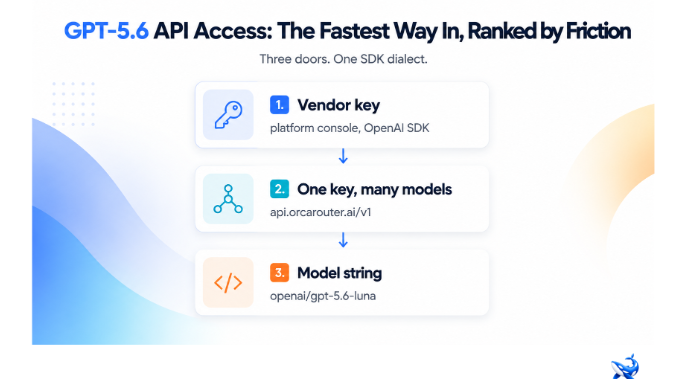
GPT-5.6 API Access: The Fastest Way In, Ranked by Friction
GPT-5.6 Luna API is OpenAI’s economy-tier reasoning model, and right now it is also the lowest-friction door into the GPT-5.6 family API: one key, an OpenAI-SDK-compatible endpoint, and a model string get you a working call at $0.20 in / $1.20 out per million tokens after the cut. The family is not one model, though — it is three, and GPT-5.6 Luna carries the live spec sheet for the economy tier, so the real decision has a single source to check. This piece is the access layer on top of that: who can actually get a key, what the model IDs look like, and where the latency really lands.
The GPT-5.6 family is generally available — Sol, Terra and Luna shipped together on July 9, 2026 — so “can I use it” is no longer the question. The question is which door costs you the least setup: OpenAI’s own API, an OpenAI-compatible platform, or the trial paths that are real but won’t carry production volume.
The access map: three doors, one SDK dialect
Every GPT-5.6 model speaks the same dialect — the OpenAI chat-completions surface — so the integration never changes; only the key and the model string do. That gives you three ways in, ordered by how much plumbing you take on.
Door one: the vendor’s own API. You create a key in the OpenAI platform console, point your SDK at it, and call the model by name. It is the canonical path, and the model is fully GA, so there is nothing provisional about it. The cost is structural: every additional provider or model family you touch is another key, another billing relationship, and another rate-limit surface to monitor.
Door two: an OpenAI-compatible platform on a shared key. Point the same SDK at a routing layer that carries many models behind one key. On OrcaRouter the model ID is openai/gpt-5.6-luna, the surface is OpenAI-SDK compatible, and the price on the model page is the post-cut $0.20 / $1.20 passed through at 0% markup. A working call is one base URL change away:
“`python
from openai import OpenAI
client = OpenAI(
base_url=”https://api.orcarouter.ai/v1″,
api_key=”YOUR_API_KEY”,
)
resp = client.chat.completions.create(
model=”openai/gpt-5.6-luna”,
messages=[
{“role”: “system”, “content”: “You are a careful senior engineer.”},
{“role”: “user”, “content”: “Summarize this changelog for a release note.”},
],
)
print(resp.choices[0].message.content)
“`
Door three: the trial paths. OpenAI offers rate-limited trial and playground-credit access, and Replit’s Free Mode now runs on Luna, per OrcaRouter’s pricing analysis. Those are for evaluation, not production — a rate-limited free path is not a substitute for a key on a workload that must not stall.
Pick a tier before you pick a door
Access mechanics are identical across the family, so choose the model first. Post-cut, the lineup reads like this, per OrcaRouter’s catalog, which passes the cut through at 0% markup:
| Model | Role | Input / output per 1M | Post-cut change |
| Sol | Flagship | $5 / $30 | unchanged from launch |
| Terra | Balanced default | $2 / $12 | ~20% off ($2.50 / $15) |
| Luna | Economy / high-volume | $0.20 / $1.20 | ~80% off launch ($1 / $6) |
Sol is the ceiling. Terra, the balanced default, dropped from $2.50 / $15 to $2 / $12. Luna went from $1 / $6 at launch to $0.20 / $1.20 — the biggest single discount in the family. One caveat: pricing varies by listing. A single outside listing quoted Luna at $0.10 / $0.60 with a separate tier above 272k prompt tokens, while both Artificial Analysis and OrcaRouter’s catalog read $0.20 / $1.20. When it matters, treat the reference here as the cut price passed through at 0% markup, and verify against your own console.
What Luna specifically buys you
The whole point of the economy tier is that the cheap model is also the fast one. Artificial Analysis’ live board, checked August 22, 2026, puts Luna’s median output speed at 156.6 tokens per second — far ahead of GPT-5.6 Sol at 73.7 and Claude Opus 5 at 61.8 — and flags the model as “notably fast”. Its Intelligence Index sits at 52.32 on the maximum-effort configuration, well above the tier median of 17; Sol scores 60.93 and Terra 56.58, so you give up roughly 8.6 index points to Sol while paying a fraction of the cost.
Cost per Intelligence Index task on the same independent board is $0.05, against $1.23 for Sol and $2.34 for Claude Opus 5. Context is the full 1,000,000 tokens. The model is multimodal — text and image input, text output — with closed weights, and Artificial Analysis ranks it among the fastest in its family.
One benchmark housekeeping note: every public number above is the maximum-effort configuration, so compare Luna max to Sol max — never to a lower-effort run.
The latency reality
Benchmark speed and production latency are different numbers, and they diverge here. Artificial Analysis reports a time-to-first-token of roughly 102 ms for Luna — a lab figure under ideal load. On OrcaRouter’s own seven-day telemetry, checked August 22, 2026, the p50 time to first token is 1.33 seconds and the p95 is 7.32 seconds, with 21,271.6M tokens moved in the week — by far the highest-volume model in the telemetry set. Two readings, same model, different questions: the sub-200 ms figure tells you the model itself starts fast; the p50 tells you what a real shared endpoint looks like under production traffic.
Frame your expectations around the p50: about a second and a third to first token is fine for batch jobs, agent loops and code-review pipelines, and wrong for anything that needs an instant first token, like autocomplete. The volume number is the useful context — 21,271.6M tokens per week is what a workhorse looks like; this is the model people actually run at scale.
Who shouldn’t bother with a direct vendor API
If your stack talks to exactly one model from exactly one vendor and has no appetite for change, the direct path is fine and you can stop reading here. If you touch more than one model family — and the GPT-5.6 family is three models, on top of whatever your workload already uses — the direct API starts costing you in integration surface, not dollars. One key that carries 200-plus models, list prices passed through at 0% markup, and automatic failover between providers removes the single-point-of-failure problem: if a model regresses, gets deprecated, or an inference cluster has a bad afternoon, you change a string rather than a codebase. A route like that stands on its own merits — the access decision stops being a per-model project.
The takeaway
Getting API access to GPT-5.6 is now a ten-minute task, not a procurement cycle. Pick the tier first — Luna at $0.20 / $1.20 after the cut is the volume workhorse, Terra the balanced default, Sol the ceiling. Budget for a production p50 around 1.33 seconds to first token, not the lab’s 102 ms. And if your workload spans more than one model, put them behind one key with pass-through pricing, so switching models is a config edit instead of a migration.
Sourcing note: Family lineup, release date, closed weights and the existence of free trial paths are OpenAI’s published statements. Intelligence Index, output speed, context window, modality and cost-per-task figures are Artificial Analysis’ independent measurements from its live board, checked August 22, 2026. Post-cut prices, the ~80% and ~20% discounts, the 0% markup pass-through, the OrcaRouter model ID, and all p50/p95 time-to-first-token and traffic figures are OrcaRouter’s own catalog and seven-day telemetry, checked the same date. One third-party listing quoted different Luna pricing; where prices differ, the reference here is the cut price passed through at 0% markup.