Guided Biofilm Therapy: A Modern Approach to Cleanings
If you have ever walked out of a dental cleaning feeling like your teeth just survived a minor construction project, you are not alone. Traditional scaling and polishing have been the backbone of professional cleanings for decades, and while they work, the experience is not exactly relaxing. Scraping instruments, sensitivity spikes, and that gritty paste spinning against your enamel are pretty standard.
But here is the thing: dentistry does not stand still. The tools and techniques evolve, and patients benefit the most when clinics actually adopt those advances. One shift picking up serious momentum in recent years is Guided Biofilm Therapy, commonly referred to as GBT. It is a structured, evidence-based protocol for professional dental cleaning that prioritizes precision, patient comfort, and thorough biofilm removal without the aggressive instrumentation most of us are used to.
What Exactly Is Biofilm, and Why Should You Care?
Before diving into the therapy itself, it helps to understand what it targets. Biofilm is that sticky, almost invisible layer of bacteria that forms on your teeth throughout the day. You know the fuzzy feeling on your teeth when you skip brushing before bed? That is biofilm doing its thing.
Left undisturbed, biofilm hardens into tartar (calculus), which cannot be removed with a toothbrush alone. Over time, this bacterial buildup leads to cavities, gum inflammation (gingivitis), and in more advanced cases, periodontal disease that damages the bone supporting your teeth. It is also linked to systemic health concerns, including cardiovascular issues and complications with diabetes.
The problem with conventional cleanings is that they often focus on what is visible and already hardened. Biofilm in its early stages is tricky to detect, so clinicians are essentially working blind in some areas. GBT flips that approach entirely.
How Guided Biofilm Therapy Actually Works
GBT follows a systematic, eight-step protocol developed through clinical research by EMS, a Swiss dental technology company. Each step builds on the last, and the whole process is designed to be thorough without being rough on your teeth or gums.
Assessment and Disclosure
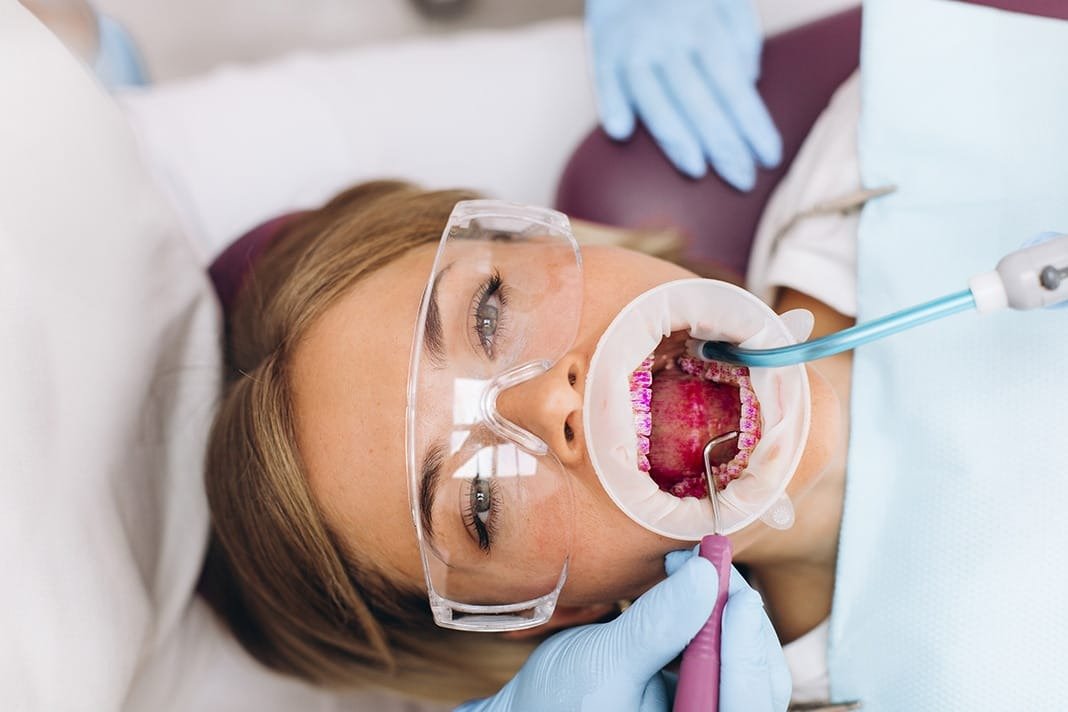
The process starts with a full oral health assessment. Your clinician reviews your dental history, checks for risk factors, and then applies a disclosing solution to your teeth. This is where things get interesting. The solution stains biofilm in bright pink and purple shades, making the invisible suddenly very visible. Older, thicker deposits appear in a different shade from newer ones, giving the clinician a real-time map of where bacteria are hiding.
Patients often find this step eye-opening. You brush twice a day, floss regularly, and still, there are spots you have been consistently missing. That visual feedback alone makes the cleaning more targeted and the home-care advice afterwards far more specific.
AIRFLOW: The Core of the Process
Once biofilm is mapped out, the clinician uses AIRFLOW technology to remove it. This device directs a controlled stream of warm water, air, and a fine erythritol-based powder onto the tooth surfaces. It gently lifts away biofilm, surface stains, and early calculus without the scraping and vibration of traditional instruments.
The powder is extremely fine, far gentler than abrasive pastes used in conventional polishing. It reaches into tight spots between teeth, along the gumline, and even around orthodontic brackets where manual instruments struggle. Patients who have experienced both traditional cleaning and AIRFLOW consistently report a significant comfort difference.
Subgingival Cleaning and Calculus Removal
For patients with deeper gum pockets or periodontal concerns, PERIOFLOW nozzles deliver the same air-powder-water combination below the gumline, disrupting biofilm without traumatizing soft tissue. Any remaining calculus is then addressed with PIEZON ultrasonic instruments, which use gentle pulsating water vibrations rather than heavy manual scaling. Precise tartar removal with minimal contact with enamel.
Why This Matters More Than Just Comfort
It is easy to dismiss GBT as a comfort upgrade, a nicer version of what dentists have always done. But the clinical reasoning behind it runs deeper than patient preference. Here is what sets it apart:
- Precision over guesswork. Disclosing biofilm before removing it means the clinician can see exactly what needs to go. No scraping blindly along tooth surfaces, hoping to catch everything.
- Less enamel damage. Traditional scaling instruments, even in skilled hands, make direct contact with enamel. Over years of regular cleanings, that contact adds up. AIRFLOW powder is non-abrasive, which preserves tooth structure over the long term.
- Better outcomes for implant patients. Dental implants require careful maintenance. Metal scalers can scratch implant surfaces, creating micro-grooves that attract more bacteria. GBT cleans around implants effectively without risking that kind of damage.
- Ideal for sensitive patients. People who dread cleanings because of tooth sensitivity or gum tenderness find GBT significantly more tolerable. Warm water, minimal contact, and no gritty polishing paste make a real difference.
Who Benefits Most from GBT?
Almost everyone who gets regular dental cleanings benefits, but certain groups stand to gain the most:
- Patients with braces or orthodontic appliances, where brackets and wires create hard-to-reach areas that trap plaque.
- Anyone managing gingivitis or early periodontal disease, where thorough subgingival cleaning is critical.
- People with dental implants or bridges, where gentle cleaning prevents damage to prosthetic surfaces.
- Patients dealing with chronic staining from coffee, tea, or smoking, where AIRFLOW removes discoloration without harsh abrasives.
- Children and anxious patients who need a less intimidating cleaning experience.
Even for patients with healthy gums, GBT raises the standard of what a routine cleaning accomplishes. You walk out knowing that bacteria were actually identified and removed rather than just scraped off.
Finding a Clinic That Does It Right
Not every dental office offers GBT, and among those that do, the quality depends on the team delivering it. You want a clinic that has invested in the proper EMS equipment, trains its hygienists on the full protocol, and takes the time to customize the treatment rather than rushing through a one-size-fits-all cleaning.
Clinics like Clean Smiles Dental Clinic in Edmonton have built their Guided Biofilm Therapy services around this approach, using the EMS AIRFLOW Prophylaxis Master Unit for GBT appointments and prioritizing warm water, patient comfort, and thorough biofilm management at every hygiene visit. That kind of commitment to the full protocol separates a genuine GBT experience from a clinic that simply owns the equipment.
What to Expect After Your First GBT Cleaning
Your teeth will feel noticeably clean, and not just polished-surface clean. The kind of clean where your tongue keeps running over your teeth because they feel genuinely smooth. Most patients report no sensitivity afterwards, in stark contrast to the tenderness that often follows traditional scaling.
One practical tip: avoid eating or drinking for about an hour after the appointment. The cleaning removes your saliva pellicle (the natural protein coating on your teeth), and it takes roughly 20 to 60 minutes for that layer to rebuild. Skipping the coffee during that window helps preserve the results.
Your clinician will also walk you through personalized home-care recommendations based on what the disclosing solution revealed. Those purple-stained spots show patterns in your brushing technique that you can actually correct, making every cleaning after that more effective.
One Protocol, Fundamentally Better Outcomes
Guided Biofilm Therapy is not a trend or a luxury add-on. It is a clinically backed shift in how dental professionals approach preventive care. The protocol exists because research has shown that complete biofilm removal is the single most important factor in preventing dental disease, and that the traditional tools used to chase that goal are more aggressive than they need to be.
If you have been going through the motions with your regular cleanings, showing up every six months, sitting through the scraping, and collecting your new toothbrush on the way out, it might be worth asking your dental office about GBT. Once you experience a cleaning that is actually guided by what your mouth needs rather than a standard checklist, it is tough to go back.