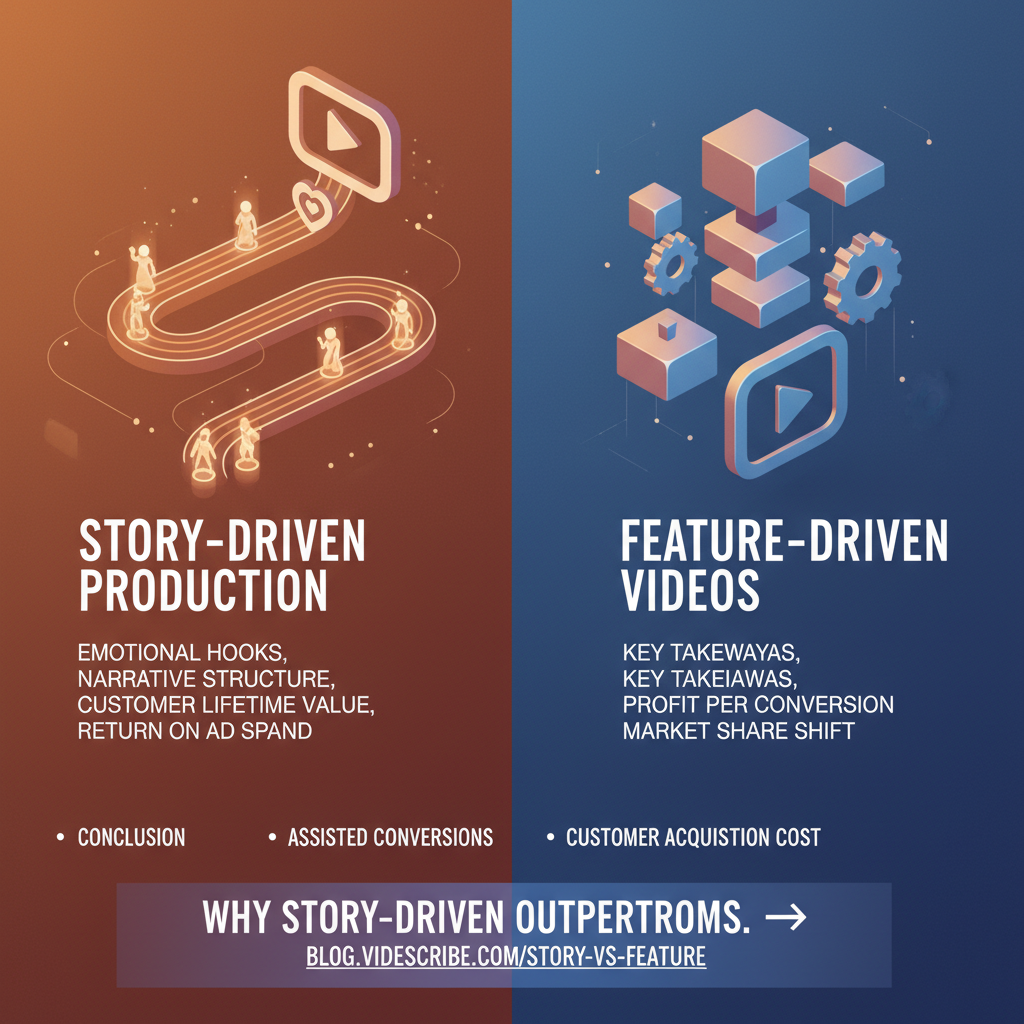
Why Story-Driven Production Outperforms Feature-Driven Videos
Ever notice how some ads just stick with you? Not because they shouted about a product’s features, but because they told you something you felt. That’s the magic of story-driven video, and honestly, it’s not magic at all – it’s just good psychology. In a world saturated with content, merely listing what your product does isn’t enough to capture attention or, more importantly, shift behavior. You need to connect, to resonate, to make people feel something. Feature-driven videos are the equivalent of reading an instruction manual aloud.
They’re informative, sure, but rarely inspiring. They tell you *what* something is. Story-driven videos, on the other hand, show you *why* it matters, *how* it changes lives, and *what it feels like* to experience the benefit. This fundamental difference is why focusing on narrative isn’t just a creative choice; it’s a strategic imperative for any brand looking to truly engage its audience.
Narrative Structure
Let’s talk structure. Every compelling story, whether it’s a blockbuster movie or a 60-second commercial, generally follows a recognizable arc. There’s a character, a challenge they face, a journey they undertake, and ultimately, a resolution or transformation. When you apply this to marketing video production, your product isn’t just a thing; it becomes the catalyst, the solution, or even the hero in someone’s story.
Think about it: people don’t buy drills because they want a drill. They buy drills because they want a hole. A feature-driven video might show you the drill’s RPM, battery life, and ergonomic grip. A story-driven video, however, might show a homeowner finally hanging that cherished family photo, the pride on their face, and the joy of a completed project, with the drill playing a subtle yet crucial role in making that moment happen.
Which one makes you want to buy the drill more? Crafting a narrative means identifying your audience’s pain points, aspirations, and daily struggles. Then, you position your product or service as the bridge from their current reality to a desired future. This isn’t about fabricating drama; it’s about finding the inherent human story within your offering. Even the most practical products have an emotional impact on users. Understanding this allows brands to move beyond mere demonstration to true storytelling.
Emotional Hooks
This brings us directly to emotional hooks, which are the heart of story psychology. Humans are emotional creatures. We make decisions based on how we feel, and then we rationalize them with logic. A video that evokes empathy, joy, relief, or even a touch of humor is far more likely to be remembered and acted upon than one that simply lists specifications. When a story resonates emotionally, it creates a connection between the viewer and the brand.
This connection isn’t fleeting; it builds trust and loyalty. Think about the campaigns from some of the top ad agencies – they consistently tap into universal human experiences. They don’t just sell products; they sell feelings, solutions to problems, and visions of a better life. Industry insights from platforms like Think with Google often highlight how crucial emotional connection is for effective advertising. They emphasize that content that makes people feel something performs better, fostering deeper engagement and recall.
It’s not about being manipulative; it’s about being human. When you share a relatable struggle or a moment of triumph, you’re inviting your audience into a shared experience, making your brand part of their world. Consider the journey your customer is on. What are their hopes? Their fears? How does your product or service alleviate those fears or fulfill those hopes? This isn’t just about showing a happy customer; it’s about illustrating the *transformation*.
It’s about showing the “before” and “after” not just in terms of product use, but in terms of emotional state and quality of life. This deeper dive into the human experience is what elevates good marketing video production from merely informational to truly influential. Ultimately, people don’t just buy products; they buy better versions of themselves, or solutions to their problems. A story-driven video helps them envision that future. It creates a powerful, memorable link between your brand and their aspirations, making your offering not just desirable, but essential. It’s about building a relationship, not just making a sale.
Key Takeaways
- Story-driven videos connect with audiences on an emotional level, fostering deeper engagement than feature-driven content.
- Narrative structure provides a compelling framework, positioning your product as the solution within a relatable human journey.
- Emotional resonance drives decision-making and builds lasting brand loyalty, moving beyond mere product specifications.
- Focusing on the “why” and “how it feels” of your offering is more impactful than simply listing “what it does.”
- Successful video marketing leverages universal human stories to create memorable and influential brand experiences.
Conclusion
In today’s crowded digital landscape, simply having a great product isn’t enough. You need to tell a great story. By embracing story-driven production, brands can move beyond the transactional and build genuine connections with their audience, turning passive viewers into active advocates. It’s an approach that not only captures attention but truly changes minds and hearts, proving that a well-told story is indeed the most powerful marketing tool we have.
Disclaimer
The content provided in this article is for informational and educational purposes only. It reflects insights, strategies, and opinions regarding video marketing techniques, including story-driven versus feature-driven production. While the article draws on industry observations and general marketing principles, it does not constitute professional advice, guarantee results, or serve as a substitute for personalized consultation. Individual outcomes may vary based on factors such as audience, product, market conditions, and execution. Readers are encouraged to apply the concepts thoughtfully and consider seeking professional guidance tailored to their specific needs.