100GBASE-ZR4 and Network Planning: Thinking Ahead Without Overcommitting
Planning for Growth Without Locking Yourself In
Network design is often a balancing act between what you need today and what you might need tomorrow. Build too small, and you run into bottlenecks quickly. Build too big, and you end up paying for capacity that sits unused for years. Somewhere in the middle is where most real decisions happen.
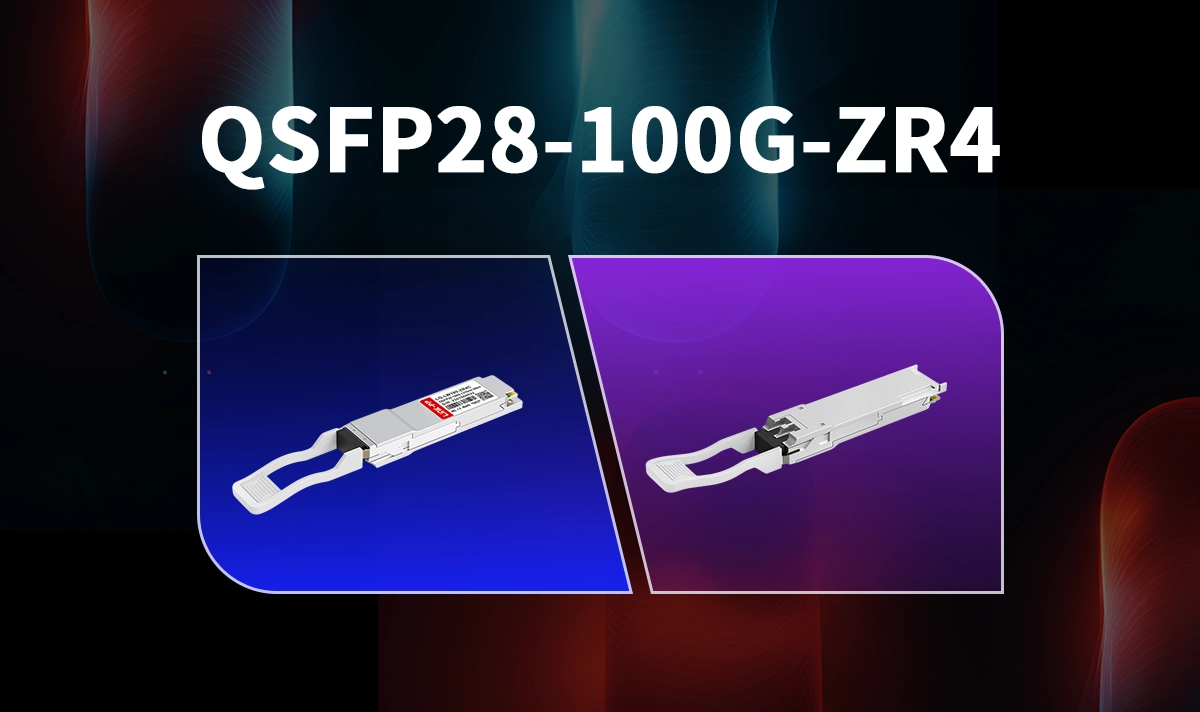
This is exactly the space where 100GBASE-ZR4 starts to make sense—not just as a technical solution, but as a planning tool. Under the IEEE 802.3 definition, ZR4 modules provide 100Gbps transmission over single-mode fiber up to around 80 kilometers. That reach covers a wide range of inter-site connections, but the more interesting part is how it fits into long-term planning without forcing immediate commitments to more complex systems. It gives you room to grow, without deciding everything upfront.
Building Links That Can Evolve Later
One of the challenges in long-distance network planning is choosing the right level of complexity from the start. If you go straight to a full optical transport system with DWDM and coherent optics, you’re preparing for future scale—but you’re also investing heavily from day one. That makes sense in large, rapidly growing environments, but not always in smaller or more controlled deployments. ZR4 offers a different starting point. You can establish direct 100G links between sites using pluggable modules, keeping the design simple at the beginning. The fiber infrastructure remains standard single-mode, and the endpoints behave like regular Ethernet interfaces.
Later, if demand increases significantly, the network can evolve. Additional wavelengths, more advanced optics, or even a full transport layer can be introduced. ZR4 doesn’t prevent that transition. It just delays the need for it until there’s a clear reason.
Avoiding Early Overengineering
There’s a tendency in network design to plan for the worst-case scenario.
“What if traffic doubles next year?”
“What if we need multiple 100G links between these sites?”
“What if we outgrow this design faster than expected?”
These are valid questions, but they can also lead to overengineering. Deploying a highly complex system before it’s actually needed can increase both cost and operational burden. It also introduces more variables that need to be managed from the beginning. With 100GBASE-ZR4, the approach is more conservative.
You deploy what you need now—a stable 100G link over the required distance—and leave room for future expansion. If traffic grows, you can add more links or transition to a different technology later. If it doesn’t, you’ve avoided unnecessary complexity. That flexibility is often more valuable than it looks on paper.
What This Means for Real Network Layouts
In practical terms, this approach shows up in networks that are still expanding but not yet at massive scale. A company might be connecting a few regional data centers, with plans to add more over time. At the beginning, traffic between sites is manageable, and a single 100G link per route is enough. ZR4 modules make it easy to establish those connections quickly.
As the network grows, some routes may require additional capacity. At that point, planners can decide whether to add more ZR4 links, introduce multiplexing, or move toward a more advanced optical system. The key point is that the initial design doesn’t limit those choices. It stays open.
Operational Consistency as Part of Planning
Planning isn’t just about capacity—it’s also about how the network will be operated. Technologies that require specialized skills or complex management systems can slow things down, especially in the early stages of deployment.
ZR4 modules behave much like other Ethernet optics. They don’t require a separate operational model. Monitoring, troubleshooting, and maintenance all follow familiar patterns. That consistency reduces the learning curve for teams and makes it easier to scale operations as the network grows. In a way, it’s not just about planning the network itself, but planning how people will manage it.
Where the Limits Start to Appear
Of course, this approach has its limits. ZR4 is designed for point-to-point links. It doesn’t offer the same spectral efficiency or flexibility as coherent optics. If the network grows to the point where multiple high-capacity links need to share the same fiber infrastructure, a more advanced solution may become necessary.
There’s also the question of long-term scalability. At some point, adding more discrete links becomes less efficient than consolidating them into a transport system. But that point doesn’t always come immediately. And until it does, ZR4 provides a simpler way to keep things moving forward.
A Tool for Phased Evolution
What makes 100GBASE-ZR4 particularly useful in planning is that it supports phased evolution. You don’t need to design the entire future network on day one. You can start with a straightforward solution, observe how traffic grows, and adjust over time. Some links may remain unchanged for years. Others may be upgraded or replaced as demand increases. The network evolves based on real usage, not just projections. That reduces risk and allows for more informed decisions.
Conclusion
100GBASE-ZR4 offers more than just long-distance 100G connectivity—it provides a flexible starting point for network planning. By enabling simple, high-capacity links over standard single-mode fiber, it allows organizations to meet current needs without committing to complex transport systems too early. As networks grow and requirements change, ZR4-based designs can evolve naturally, supporting a phased approach to expansion. In environments where balancing present demands with future uncertainty is key, this kind of adaptability becomes a significant advantage.